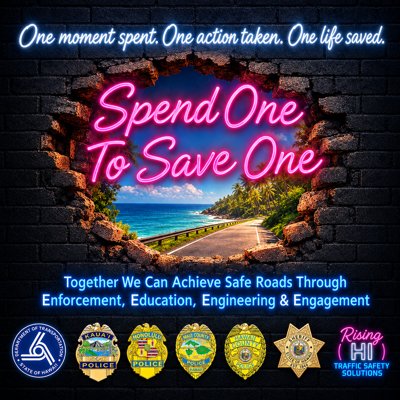
 Spend One to Save One
These were not accidents
A note from James "Slate" Slayter, Hawaiʻi Law Enforcement Liaison and retired Honolulu Police Department Major.
With about three decades devoted to law enforcement and criminal justice, I found an unexpected passion for traffic safety. As a youth, I was one of the "racer boys." I worked multiple jobs in the automotive industry while putting myself through the administration of justice program at Honolulu Community College. In my free time I was at car meets, cruising Waikīkī, and making runs on Tantalus or at Kalaeloa Raceway Park.
In our youth we all think we're invincible and that the bad stuff won't happen to us. It wasn't until I got stopped by a solo bike officer, only weeks away from entering the police academy, that I changed my trajectory. I didn't get a ticket. But I sure got a lesson. The message was clear: get your act together or you're going to get killed. It resonated.
In recruit school, crimes related to traffic safety were considered "victimless." Not much emphasis was put on the traffic code or even impaired driving. Then in the summer of 1996, on my first night on the road as a patrol officer in Kalihi, my beat partners and I, along with some innocent motorists, were almost killed by an impaired driver.
It was about 11 p.m. We were in the left lane of the Moanalua Freeway, westbound, finishing a collision investigation and waiting for a tow truck to take a stalled vehicle. Out of nowhere, a white Ford Bronco came barreling into our work area, bounced off the center median, and hit the stalled vehicle exactly where we had been standing. I had to jump over the median into oncoming traffic on the other side of the freeway. If it were not for a good driver headed eastbound, paying attention, driving the speed limit, and sober, I would not be here. I held pressure on a young passenger's neck wound until EMS arrived. Everyone survived that night. The driver of the Bronco was almost triple the legal limit.
Since then, I have responded to hundreds of crash scenes, many involving critical or fatal injuries. I assure you, these were not accidents. These crashes were preventable, and the common factors are not a secret. The great majority of serious crashes are caused by dangerous choices: speeding, driving impaired, or driving distracted.
I didn't think much about traffic safety even when I was writing tickets. That was more about crime reduction. It wasn't until I became a commander in the Traffic Division's Vehicular Homicide Section that I saw the senseless deaths caused by irresponsible or reckless drivers, and that the victims were innocently doing what every one of us does every day.
Many of you have had the unfortunate task of comforting the family and friends of a victim at a crash scene. You know the numbers are far more than numbers. Each death is someone who won't be there for the next family gathering, wedding, birthday, or holiday. One crash, caused by one reckless or irresponsible driver, affects so many people.
The best public service announcement I have ever seen is one from New Zealand. A man is asked what an acceptable number of traffic deaths is each year. He gives a number, and then that exact number of his own family members walks out from behind a wall. He no longer believes any number other than zero is acceptable. That is the message we need to spread.
How drivers behave is strongly influenced by what they see other drivers doing, and by how they see officers responding, or not responding, to violations. When drivers see traffic laws enforced, they recognize safe driving as a social expectation. When violations are ignored, dangerous driving becomes the norm. That is why this campaign asks officers for one focused hour, partners for one action a month, and every commuter for one minute before every trip.
I've been asked hundreds of times: don't you have something better to do? My answer is no. There is nothing more important than saving your life, or the life of some other innocent person.
We've lost too many lives on our roads. These are preventable deaths, and we have the tools to stop them. We are all in this together, and together we can save lives.
Mahalo,
Slate